What Documentation Government Buyers Need When Purchasing Scales
Sales
29-Apr-26
Government procurement teams don’t just buy a scale—they buy a defensible measurement system. That means documentation matters as much as capacity, readability, and price. Whether you’re purchasing for logistics, evidence, warehousing, labs, or field operations, having the right paperwork ready reduces delays at receiving, speeds acceptance, and supports audits.
Below is a clear checklist of the most common government scale purchase documentation that agencies request, including GSA scale documentation requirements, scale compliance documentation government expectations, and calibration documentation government scales best practices.
Why government buyers require scale documentation
Government purchasers typically need documentation to:
- Verify the product meets the solicitation/spec requirements
- Support quality programs and audits
- Ensure traceability for critical measurements
- Confirm legal-for-trade suitability when weight affects billing, fees, penalties, or regulated transactions
This is why "missing paperwork" can hold up delivery-even if the scale itself is correct.
1) Core government scale purchase documentation (procurement essentials)
Most agencies will want a clean procurement trail and basic industrial scale documentation, such as:
- Quote and itemized invoice (model, capacity, readability, options/accessories)
- Packing list/shipping documentation
- Warranty documentation
- Operator's manual
- Product datasheet/spec sheet (often used during receiving and acceptance)
A simple but important tip: make sure model numbers match across the quote, invoice, packing list, and any certificates
2) GSA scale documentation requirements: what's commonly requested
Specific GSA scale documentation requirements vary by contract and agency, but many buyers ask for a documentation bundle that supports:
- Compliance with solicitation performance requirements
- Legal-for-trade documentation when applicable
- Calibration documentation and traceability needed for acceptance
- Manufacturer certifications that back up claims in the listing or spec
If you expect the scale to be inspected by QA or used in a regulated program, plan ahead for a full compliance packet.
3) NTEP certification documentation (when "legal for trade" matters)
If the scale will be used where weight impacts money, regulated transactions, or enforcement actions, buyers often require proof of legal-for-trade suitability.
That typically means providing NTEP certification documentation, such as:
- An NTEP Certificate of Conformance (CoC)
- Confirmation that the exact configuration is covered (indicator/base/capacity divisions)
This is a cornerstone of scale compliance documentation that government teams rely on-especially for procurement, inspections, and audits.
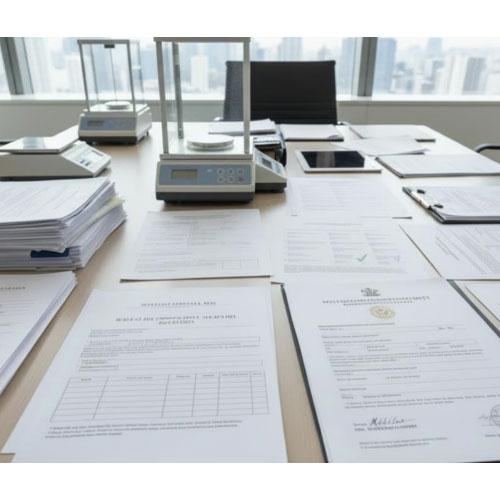
4) Calibration documentation for government scales (what agencies want to see)
Calibration needs vary by mission and internal standards, but calibration documentation government scales usually must support traceability and repeatability.
Common requests include:
- Calibration certificate/calibration report
Often required elements:
- Scale identification (model + serial number, and sometimes asset tag)
- Date performed
- Test results (as-found/as-left or pass/fail)
- Standards used and traceability references
- Uncertainty (frequently requested for lab or high-accuracy programs)
- Scale calibration records (ongoing)
Many agencies maintain historical scale calibration records for each asset. Buyers may ask how calibration will be documented over time and what interval is recommended.
- Calibration interval guidance
While not always "official paperwork," it's often requested for onboarding and QA planning.
5) Other weighing equipment compliance documents you may need
Depending on the application and agency, additional weighing equipment compliance documents may include:
- Statement of compliance to solicitation specs
- Setup/installation instructions and acceptance test procedures
- Maintenance schedule and service documentation
- Software/firmware version information (if required)
- Security sealing or audit trail information (regulated or legal-for-trade environments)
When in doubt, ask early: "Is this for legal-for-trade use?" and "Do you require calibration at delivery?"
6) Matching documentation to the type of scale being purchased
Different missions drive different documentation needs. For example:
- Warehouse and shipping programs often focus on ruggedness, repeatability, and audit-ready calibration.
- Inventory and parts programs often want strong counting performance and clear verification procedures.
- Field teams may need compact equipment plus clear calibration and handling guidance.
If you're sourcing equipment by category, you can review common options like digital scales for general-purpose needs, compact pocket scales for portability, or counting scales for inventory and parts counting workflows.
7) A quick checklist for government scale purchase documentation
Use this list in your requisition or RFQ package:
- Quote/invoice + packing list (matching model numbers)
- Datasheet/spec sheet + user manual
- Warranty documentation
- NTEP certification documentation (if legal-for-trade or solicitation requires)
- Calibration documentation government scales (certificate/report if required at delivery)
- Plan for ongoing scale calibration records (interval + method)
- Any agency-required weighing equipment compliance documents (acceptance tests, conformance statements, etc.)
How to Order from Scales Galore
Scales Galore at scalesgalore.com, a division of Itin Scale Co., Inc., supports government and contractor buyers who need straightforward purchasing and the documentation needed for receiving and acceptance.
How to Order
- Secure online ordering with VISA, MasterCard, American Express, Discover, or PayPal
- Telephone: 800-832-0055 or 718-336-5900
- For Alaska and Hawaii, international customers, and wire transfers, contact us for options
Related Articles
16-Mar-26
GSA Scale Vendors: What to Look for Before You Buy?
Learn what to look for in GSA-approved scale vendors. From compliance and GSA contract coverage to post-purchase calibration support, discover the key factors to consider before you buy industrial scales for government use. ...
09-Mar-26
GSA-Approved Scales: What Compliance Requirements Matter Most?
Purchasing scales for government use isn't as simple as picking a reliable product off the shelf. Compliance requirements for GSA-approved scales are strict to ensure accuracy, reliability, and adherence to federal guidelines. Whether you're looking for NTEP-certified scales, NIST compliance, ISO certifications, or navigating the Buy American Act and TAA requirements, understanding these standards is essential. ...
17-Feb-26
How to Justify a Scale Purchase in a Government Procurement Request
Government agencies purchase scales for a wide range of operational needs — from logistics and warehousing to inspection, manufacturing, and regulated environments. However, unlike commercial purchases, government acquisitions must be clearly justified, properly documented, and aligned with applicable compliance standards. ...
28-Nov-11
HLWP IP65 Waterproof food service Scale
AND is renowned for its innovations and quality products used in science, medicine, research, and the home. The AND Weighing Division is an ISO 9001 certified company ...
15-Nov-11
Sartorius M-PROVE line of economical portable balances
Sartorius, a leader in laboratory mechanics for over a century, has recently introduced a line of economical portable balances called the M-Prove series. The M-Prove balances were developed to be accurate for use in laboratory applications yet rugged enough to take on the road. ...
14-Nov-11
Ohaus Scout Pro line of scales
The Ohaus scout pro has been one of the longest and best selling scales for portable and stationary weighing. ...